EMT Practice Test

1. Question Content...


Question List

Question1: Which three design requirements must be satisfied to enable RAID-6 objects in a VMware vSAN cluster?
(Choose three.)

Question2: What is the minimum number of hosts that must contribute capacity to a non-ROBO single site VMware vSAN cluster?

Question3: What are two features introduced in Network I/O Control version 3? (Choose two.)

Question4: Which three prerequisites must be in place prior to enabling secure boot for a virtual machine? (Choose three.)

Question5: Which two statements are true for a vCenterServer user account that is used for vSphere Data Protection (VDP)? (Choose two.)

Question6: Which three vSphere features are compatible with vSphere Replication? (Choose three.)

Question7: An administrator has enabled vSphere Distributed Switch Health Check. The hosts connected to that Distributed Switch all display an alert:
vSphere Distributed Switch MTU supported status
The administrator has all of the VMkernel ports MTU sizes set to 1600.
Which action will remedy this problem?

Question8: An administrator sets the Failover Capacity for both CPU and Memory at 25%.
Based on the Exhibit below, how much of the cluster's total CPU resources are still available to power on additional virtual machines?

Question9: Which two items are required to enable NPIV in a virtual machine? (Choose two.)

Question10: Which are two vCenter Server two-factor authentication methods? (Choose two.)

Question11: Boot from SAN is supported on which three storage technologies? (Choose three.)

Question12: What is the minimum disk space required to deploy vSphere Data Protection (VDP) with 8 TB configuration?

Question13: A security officer has issued a new directive that users will no longer have access to change connected network adapters to limit denial of service on a virtual machine.
Which two correct virtual machine advanced configuration parameters will accomplish this? (Choose two.)

Question14: Which two storage configurations on the source server are unsupported with VMware Converter? (Choose two.)

Question15: The vSphere Data Protection performance analysis results in the "Conditionally Passed" status.
What can cause this condition?

Question16: "OneAppServer" is a VM template stored in a content library named "LibraryOne", but the vSphere administrator is not able to use this template for deployment.
Why is the administrator unable to deploy OneAppServer?

Question17: An administrator finds that the Microsoft Exchange virtual machines are exhibiting network latency.
What two in-guest changes can help decrease latency? (Choose two.)

Question18: An administrator cannot enable multi-processor Fault Tolerance (SMP-FT) for a virtual machine.
Which are two possible causes for this? (Choose two.)

Question19: Which two new vSphere 6.5 features enable an Administrator to locate configuration options when creating or editing host profiles more easily than in previous versions? (Choose two.)

Question20: Which three types of Content Libraries exist within vSphere 6.5? (Choose three.)

Question21: A user is given the "Virtual machine user (sample)" role in a vSphere 6.x environment.
Which three permissions would the user be able to perform? (Choose three.)

Question22: An administrator has recently upgraded from vSphere 6.0 to 6.5, and can no longer see the software iSCSI named vmhba33.
Which could be the reason for this?

Question23: What are two requirements to enable EVC in vSphere DRS cluster? (Choose two.)

Question24: Which three VMware-recommended best practices should an administrator follow before upgrading to vSphere 6.5? (Choose three.)

Question25: What counter should an administrator check to determine if a virtual machine is ballooning?

Question26: Which port is used for vSphere HA agent-to-agent communication?

Question27: Which metric in the Exhibit would identify high latency for a virtual machine operating system?

Question28: What is the result of a "Consolidate" action on a virtual machine?

Question29: Which statement applies to the vSphere Replication appliance?

Question30: Which two components are part of storage I/O multipathing on ESXi? (Choose two.)

Question31: Which iSCSI initiator type can be used with any network interface card?

Question32: Which Host Profile Subprofile configuration is used to configure firewall settings for ESXi hosts?

Question33: Which two types of iSCSI adapters require VMkernel networking configuration? (Choose two.)

Question34: Which two virtual NICs support Wake-on-Lan to resume a virtual machine that is in standby mode?
(Choose two)

Question35: vSphere Availability considers which two factors for virtual machine restarts? (Choose two.)

Question36: The business managers have asked the IT administrator to ensure configuration compliance in the vSphere infrastructure. The IT administrator wants to use Host Profiles to accomplish this, but is unable to do so.
Why is the administrator unable to use Host Profiles?

Question37: Which two tasks should a vSphere administrator perform if the vmkernel log reports VMFS metadata errors? (Choose two.)

Question38: Which three statements are correct regarding booting an ESXi Host from Fibre Channel SAN? (Choose three.)

Question39: Which statement regarding datastore clusters meets VMware's recommended best practices?

Question40: Which two configuration options can exclude virtual disks from snapshot operations? (Choose two.)

Question41: Which are the two network requirements for a VMware vSAN 6.5 cluster? (Choose two.)

Question42: Which two statements about vCenter HA are correct? (Choose two.)

Question43: When migrating a Windows vCenter Server 6.0 to the vCenter Server Appliance 6.5, which two will be migrated by default? (Choose two.)

Question44: By default, how often is the vCenter vpx user password automatically changed?

Question45: Which two statements are true for NFS v4.1 firewall behavior? (Choose two.)

Question46: An administrator is attempting to access an ESXi host via the DCUI but is unable to do so.
Which could be two possible causes? (Choose two.)

Question47: When installing vCenter Converter Standalone, why must an administrator perform a client-server installation instead of a local installation?

Question48: Which two options can optimize conversion with VMware Converter? (Choose two.)

Question49: Which storage feature always requires the use of third-party software on ESXi?

Question50: What advanced option for vSphere HA defines a maximum number of reset attempts by VMCP for a virtual machine?

Question51: A vSphere Administrator wants to reserve 0.5 Gbps for virtual machines on each uplink on a disturbed switch that has 10 uplinks.
What is the quota that should be reserved for the network resource pool?

Question52: Which is required by vCenter Converter Standalone to convert a physical Red Hat Enterprise Linux 7 machine to a virtual machine?

Question53: What configuration option would ensure that a virtual NUMA topology is defined on VMs having more than eight virtual CPUs?

Question54: Which is the correct order for upgrading vSphere components?

Question55: Which is the maximum number of block devices (LUNs) that are supported by ESXi hosts that are running version 6.5?

Question56: What VM Monitoring setting would ensure that the failure interval for a virtual machine is defined as 120 seconds?

Question57: A vSphere administrator observes a CPU spike on one of the web servers (view the Exhibit.)

Which two statements can describe the cause of this activity? (Choose two.)

Question58: A vSphere HA cluster with four hosts has admission control configured to tolerate one host failure.
Which statement is true if a fifth host is added?

Question59: An administrator is attempting to power on a virtual machine with 32GB of memory. The operation fails with the following error:
Could not power on VM: No space left on device
Checking the space on the virtual machine's datastore, there is 30GB free.
Which action would allow the VM to power on?

Question60: vSphere DRS helps to balance virtual machines with available resources in a vSphere cluster.
What three types of resources can be taken into account for balancing? (Choose three.)

Question61: What is the VMware-recommended best practice for Fibre Channel zoning?

Question62: Which two logs should be examined to troubleshoot a Windows vCenter Server upgrade failure? (Choose two.)

Question63: A vSphere Administrator must ensure that a user is able to view and manage the system configuration in vSphere Web Client.
In the vCenter Single Sign-On domain, which group should the user be a part of?

Question64: An ESXi host's VMCA-Signed certificate has expired. How can the certificate be renewed?

Question65: Assume that all ESXi hosts need several default settings changed to custom values to comply with internal practices, and compliance must be routinely audited.
What vSphere technology enables the administrator to ensure consistent configuration at scale?

Question66: An administrator is creating VMkernel adapters on an ESXi 6.5 host and wants to create separate VMkernel adapters for every type of traffic in the default TCP/IP stack.
Which three types of traffic can be explicitly enabled on a separate VMkernel adapter? (Choose three.)

Question67: Which method is supported for backing up the virtual machine that contains vCenter Server?

Question68: What is the correct way to replace the certificate on an existing vCenter Server that is part of a vCenter HA configuration?

Question69: Which CLI command shows the physical uplink status for a vmnic?

Question70: When performing a vCenter Server 5.5 for Windows with Microsoft SQL Server Express database migration to vCenter Server Appliance 6.5, which will be the target database?

Question71: When enabling Storage DRS on a datastore cluster, which three components are enabled as a result?
(Choose three.)

Question72: What three conditions could result in VMware Flash Read Cache being unable to claim a disk? (Choose three.)

Question73: vCenter Server Appliance Instance can be backed up using which Client Interface?

Question74: The storage vendor recommends adjusting the Fibre Channel HBA queue depth to resolve a performance problem.
Which esxcli namespace can a vSphere Administrator use to adjust the queue depth?

Question75: Which two choices are applicable to vSphere Availability? (Choose two.)

Question76: Which three requirements are needed to apply RAID 5 or RAID 6 erasure coding on a vSAN 6.2 or 6.5 object? (Choose three.)

Question77: Which three storage protocols are supported by Virtual Volumes? (Choose three.)
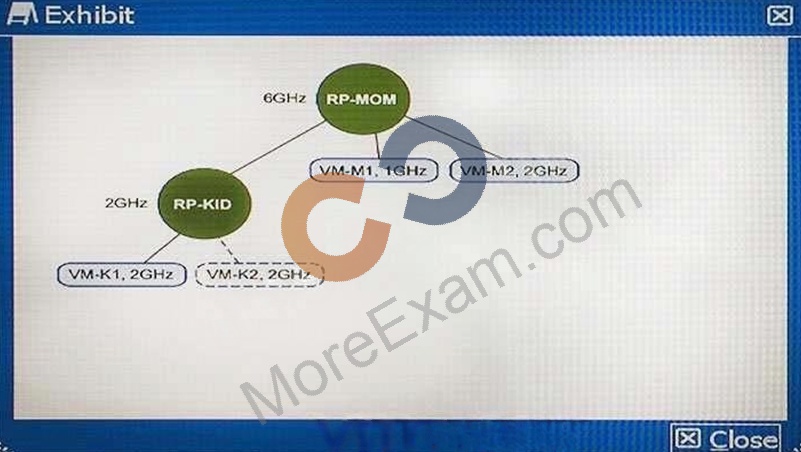
Question78: The administrator wants to power on VM-K2, which has a 2GHz CPU reservation. VM-M1, VM-M2, and VM-K1 are all powered on. VM-K2 is not powered on.
The exhibit shows the parent and child resource reservations.

If Resource Pool RP-KID is configured with an expandable reservation, which statement is true?

Question79: In network troubleshooting it is important to know what upstream switch the ESXi host is connected to.
Which two features does ESXi provide to help identify the upstream switch? (Choose two.)

Question80: A vSphere administrator manages a cluster which includes critical and non-critical virtual machines. The cluster requires different permissions for contractors and non-contractors.
How can the administrator exclude the contractor group from some of the critical VMs?

Question81: Which are three supported storage requirements for vCenter Server HA? (Choose three.)

Question82: What VM Monitoring setting would ensure that the maximum reset window for a virtual machine is 24 hours?

Question83: Virtual Volumes supports which three VMware features? (Choose three.)

Question84: An administrator wishes to enable network port mirroring based on source port. Which feature should be enabled?

Question85: An administrator has multiple vCenter Server 6.5 systems but cannot enable Storage I/O Control (SIOC) on a datastore shared by ESXi hosts managed by the vCenter Server systems.
Which action should the administrator take to resolve the issue?

Question86: What two VMware Remote Console Options can be defined in the virtual machine settings? (Choose two.)

Question87: Which guest operating system supports PVRDMA?

Question88: A vSphere Administrator attempts to enable Fault Tolerance for a virtual machine but receives the following error:
Secondary VM could not be powered on as there are no compatible hosts that can accommodate it.
What two options could cause this error? (Choose two.)

Question89: VMware Converter can import a powered off virtual machine from which two virtual machine platforms?
(Choose two.)

Question90: Which two situations could cause a virtual machine to appear with (orphaned) appended to its name?
(Choose two.)

Question91: Which two ports are open by default on the ESXi firewall? (Choose two)

Question92: Which are two supported storage primitives for VAAI NAS? (Choose two.)

Question93: Which two permissions are required to migrate a virtual machine with Storage vMotion? (Choose two.)

Question94: Where would a vSphere administrator find general vCenter Server logs on a vCenter Server Appliance?

Question95: A Telco customer is implementing NFV using vSphere as the virtualization platform.
Which feature can help achieve a high packet rate with lower CPU consumption?

Question96: The virtual machine log rotation size can be changed for all VMs by which two interfaces? (Choose two.)

Question97: An administrator has upgraded to vSphere 6.5 and also wants to use Kerberos authentication for NFS.
Which can be done to the existing NFSv3 volumes to enable this feature?

Question98: What are two requirements in order to restore a Resource Pool Tree from a snapshot? (Choose two.)

Question99: Storage capabilities be populated in what two ways? (Choose two.)

Question100: Which three are supported upgrade processes for ESXi host? (Choose three.)

Question101: What new feature is introduced in NFS 4.1 on ESXi 6.5?

Question102: Which command can be run to troubleshoot connectivity problems with vmkernal network interfaces?

Question103: Which two statements are true for Predictive DRS? (Choose two.)

Question104: An administrator sees the following error in the log files:

Which two events could be the source of the error message? (Choose two.)

Question105: An administrator is trying to vMotion a VM from his datacenter to a recovery site. Which is the maximum allowed RTT (Round-Trip Time) latency between source and destination host?

Question106: A vSphere Administrator has VM Component Protection (VMCP) enabled, but the VM was not restarted when one of the VMFS datastores experienced an All Paths Down (APD) failure.
What two scenarios would explain why the virtual machine was not restarted? (Choose two.)

Question107: In vSphere Data Protection 6.1, which is the function of a Backup Verification job?

Question108: Which is required for configuring iSCSI Software Adapter network port binding?

Question109: An attempt to delete NFS datastore from a ESXi host returns the error:
Sysinfo error on operation returned the following status: Busy
Which two statements could explain this failure? (Choose two.)

Question110: How can a vSphere administrator ensure that a set of virtual machines run on different hosts in a DRS cluster?

Question111: Which two statements are true about Highly Available vSphere Auto Deploy infrastructure? (Choose two.)

Question112: Which two parameters must be configured for Windows in-guest disk mirroring? (Choose two.)

Question113: An administrator wants to restore the vCenter Server Appliance 6.5 from backup.
Where can this be accomplished?

Question114: An administrator attempts to manually reclaim space on thin-provisioned VMFS6 volumes but finds that no additional space is being recovered.
Which could be causing this?

Question115: Which is the block size on the VMFS6 datastore?

Question116: An administrator is troubleshooting network communications between a vCenter Server and an ESXi 6.5 host.
Which log shows the related events between these components?

Question117: What tool can capture network traffic at the uplinks, or vSwitch, or virtual port levels?

Question118: A user is a member of groups A and B.
-VM10 and VM20 are in VM Folder.
-Group A is assigned permission "Read-only" on VM Folder.
What two configurations will allow the user to edit the settings for only VM10? (Choose two.)